Boeing B737-600/700/800/900
Boeing, 1997 · Commercial Aircraft
The Boeing 737 is an American narrow-body aircraft produced by Boeing at its factories in Washington state. Developed to supplement the Boeing 727 on short and thin routes, the twinjet retained the 707 fuselage width and six abreast seating but with two underwing Pratt & Whitney JT8D low-bypass turbofan engines. Envisioned in 1964, the initial 737-100 made its first flight in April 1967 and entered service in February 1968 with Lufthansa. The lengthened 737-200 entered service in April 1968, and evolved through four generations, offering several variants for 85 to 215 passengers.
Introduced in 1997, the third generation 737 Next Generation (NG) -600/700/800/900 variants have updated CFM56-7 high-bypass turbofans, a larger wing and an upgraded glass cockpit, and seat 108 to 215 passengers.
737 NG (third generation)
The Boeing 737 Next Generation, abbreviated as 737 Next Gen or 737NG, is the name given to the -600, -700, -800 and -900 variants. It has been produced since 1996 and introduced in 1997, with a total order of 7,097 aircraft, of which 7,031 have been delivered as of May 2019. The primary goal was to re-engine the 737 with the high bypass ratio CFM56-7. By the early 1990s, as the MD-80 slowly withdrew from the competition following the introduction of the MD-90, it had become clear that the new A320 family was a serious threat to Boeing’s market share. Airbus won previously loyal 737 customers, such as Lufthansa and United Airlines. In November 1993, to stay in the single aisle competition, Boeing’s board of directors authorized the Next Generation program to mainly upgrade the 737 Classic series. In late 1993, after engineering trade studies and discussions with major customers, Boeing proceeded to launch a second derivative of the Boeing 737, the 737 Next Generation (NG) -600/700/800/900 series. It featured a redesigned wing with a wider wingspan and larger area, greater fuel capacity, longer range and higher MTOWs. It was equipped with CFM56-7 high pressure ratio engines, a glass cockpit, and upgraded interior configurations. The four main models of the series can accommodate seating for 108 to 215 passengers. It was further developed into additional versions such as the corporate Boeing Business Jet (BBJ) and military P-8 Poseidon aircraft. Following the merger between Boeing with McDonnell Douglas in 1997, the primary competitor for the 737NG series remained only the A320 family.
737-600
The 737-600 was the smallest of the Next-Generation models, replacing the 737-500. It had no winglets and was similar in size to the Airbus A318. Launch customer Scandinavian Airlines (SAS) placed its order in March 1995 and took the first delivery in September 1998. A total of 69 aircraft were produced, with the last one delivered to WestJet in 2006.
737-700
The 737-700, the first variant of the Next-Generation, was launched in November 1993 with an order of 63 aircraft. The -700 seats 126 passengers in a two-class or 149 passengers in a one-class layout. Launch customer Southwest Airlines took the first delivery in December 1997. The 737-700 replaced the 737-300 and competes with the Airbus A319.
The 737-700C is a convertible version where the seats can be removed to carry cargo instead. There is a large door on the left side of the aircraft. The United States Navy was the launch customer for the 737-700C under the military designation C-40 Clipper.
The 737-700ER (Extended Range) was launched on January 31, 2006, and featured the fuselage of the 737-700 and the wings and landing gear of the 737-800. A 737-700ER can typically accommodate 126 passengers in two classes with a range similar to the Airbus A319LR.
737-800
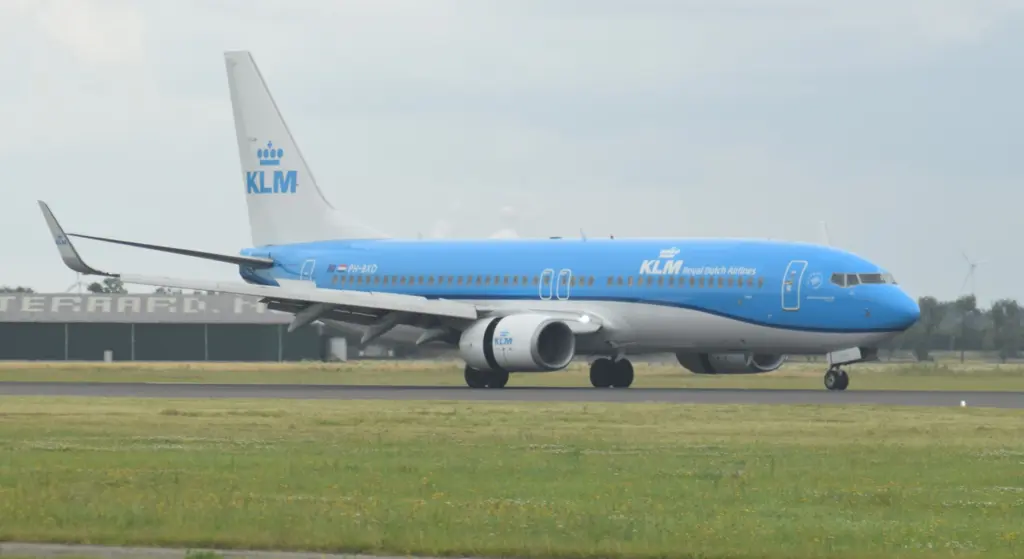
The 737-800 was a stretched version of the 737-700 launched on September 5, 1994, and first flew on July 31, 1997. The -800 seats 162 passengers in a two-class or 189 passengers in a high-density, one-class layout. Launch customer Hapag-Lloyd Flug (now TUIfly) received the first one in April 1998. The 737-800 replaced directly the -400 and aging 727-200 of US airlines. It filled also the gap left by Boeing’s decision to discontinue the MD-80 and MD-90 aircraft, following Boeing’s merger with McDonnell Douglas. The 737-800 is the most widely used narrowbody aircraft and competes primarily with the Airbus A320
737-900
The 737-900 was launched in November 1997 and took its first flight on August 3, 2000.[81][82] It is longer than the -800, but retains the MTOW, fuel capacity, and exit configuration of the -800, essentially trading range for capacity. The exit configuration limits its seat capacity to approximately 177 in a two class and 189 in a high-density, one class layout. Launch customer Alaska Airlines received the first delivery in May 2001. Fifty-two were built.
The 737-900ER (Extended Range), the newest and largest variant of the 737NG generation, was launched in July 2005, first flew in September 2006, and first delivered to launch customer Lion Air in April 2007. An additional pair of exit doors and a flat rear pressure bulkhead increased its seating capacity to 180 passengers in a two-class and up to 220 passengers in a one-class configuration.
The -900ER partly closed the gap left by the discontinuation of the Boeing 757-200, and directly competes with the Airbus A321